Marketing an Edinburgh landmark can present unique opportunities and challenges. In this article, we’ll explore strategies and best practices for marketing an Edinburgh landmark effectively.
Port Hamilton – Case Study
A lesson in how architecture and branding evolve together
Introduction
Some places tell the story of a city.
Port Hamilton is one of them.
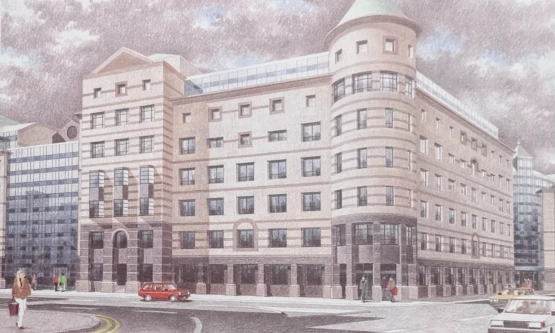
Originally completed in 1826 as an extension basin of Edinburgh’s Union Canal, the site was created to accommodate growing coal traffic when neighbouring Port Hopetoun reached capacity. More than a century later, the basin would give way to one of Scotland’s most recognisable commercial buildings, becoming the headquarters of Scottish Widows and a landmark on Edinburgh’s western approach.
Yet Port Hamilton tells another story too.
It demonstrates how architecture, branding, and business aspirations evolve together.
Buildings are often viewed as fixed assets, while brands are perceived as more transient. In reality, both are products of their time, reflecting prevailing attitudes, ambitions, aesthetics, and cultural values.
When the owners sought to position Port Hamilton for a new generation of occupiers, the challenge extended far beyond marketing office space. The ambition was to create a workplace aligned with contemporary expectations around sustainability, wellbeing, flexibility, and design excellence, while respecting the heritage and significance of the site itself.
To help communicate that vision, the development team turned to IDEAS.
Working alongside the developers and wider marketing team, IDEAS was appointed to create the brand identity, positioning strategy, sales materials, and visual communications needed to establish Port Hamilton as one of Edinburgh’s most desirable business destinations.
The Challenge
Commercial property presents a unique communications challenge.
Long before a building is occupied, perceptions have already been formed.
Investment decisions, leasing conversations, and market confidence are often established years before the first tenant arrives. Yet many of the qualities that define an exceptional workplace — atmosphere, experience, wellbeing, sustainability, materials, and culture — cannot be fully experienced during the early stages of marketing.
For Port Hamilton, the challenge was therefore not simply to promote a development.
It was to create confidence in a future experience.
The project required a compelling identity capable of communicating the scale of the ambition, the quality of the environment being created, and the commercial advantages of the location, while differentiating Port Hamilton within an increasingly competitive Edinburgh office market.
Just as importantly, the brand needed to feel as contemporary and forward-looking as the architecture itself.
Our Intervention
Under the creative direction of Don Jack, IDEAS developed a strategic brand and communications programme designed to position Port Hamilton as one of Edinburgh’s most attractive business destinations.
The objective was not simply to market a building, but to create a distinctive proposition that connected location, heritage, architecture, sustainability, and commercial opportunity.
The programme included:
Brand identity development – creating a visual identity aligned with the building’s ambitions and future positioning.
Strategic market positioning – establishing key messages and differentiators for prospective occupiers and stakeholders.
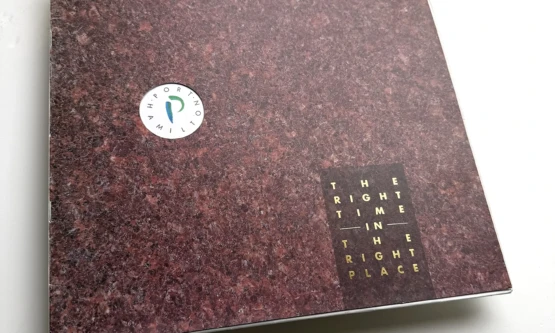
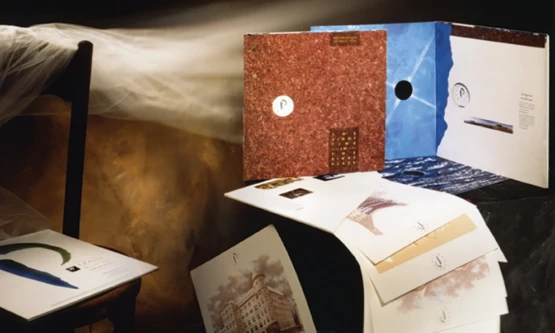
Marketing collateral – producing premium brochures and supporting materials to communicate the development’s credentials.
Marketing suite and exhibition materials – creating immersive presentation tools that allowed audiences to engage with the vision before completion.
Project storytelling – connecting the building’s canal-side heritage with its future role as a sustainable workplace destination.
Cross-platform communications – ensuring consistency across sales, marketing, stakeholder, and promotional channels.
The result was a coherent and highly professional brand platform capable of supporting the development throughout its marketing lifecycle and beyond.
Campaign & Strategy
The communications strategy focused on translating architectural quality into meaningful commercial value.
Rather than concentrating solely on floorplates, specifications, or technical performance, IDEAS positioned Port Hamilton around the experience it would offer future occupiers.
The campaign combined:
- Place-led storytelling celebrating the site’s relationship with Edinburgh’s historic canal basin.
- Future-focused messaging highlighting sustainability, wellbeing, and workplace transformation.
- Premium visual communications reflecting the quality and ambition of the development.
- Sales and stakeholder engagement materials supporting leasing conversations and market awareness.
- Exhibition and presentation environments enabling audiences to visualise the completed development long before construction was complete.
The strategy ensured that Port Hamilton entered the marketplace with a strong identity and a compelling narrative capable of supporting both commercial objectives and long-term reputation.
What We Delivered
| Strategy & Insight | Creative & Delivery |
|---|---|
| Commercial positioning strategy | Brand identity creation |
| Occupier audience analysis | Marketing brochure development |
| Place and heritage narrative | Marketing suite materials |
| Stakeholder communication planning | Exhibition and presentation assets |
| Market differentiation strategy | Visual communications system |
| Long-term brand positioning | Cross-platform marketing collateral |
Results & Legacy
Perhaps the most telling measure of success came from an unexpected source.
Having witnessed the impact of IDEAS’ work on Port Hamilton, both the project’s architects and legal advisers subsequently commissioned IDEAS to undertake rebranding and marketing initiatives for their own organisations.
It was an endorsement that spoke volumes.
When the professionals responsible for designing, advising, and delivering a major development choose to adopt the same creative approach for their own businesses, it reflects a level of confidence that extends well beyond a single project.
But perhaps the greater lesson has emerged with the passing of time.
The original Port Hamilton branding, like the architecture itself, was a reflection of its era. It embodied the values, aspirations, and aesthetic sensibilities of the late twentieth century just as faithfully as the building embodied contemporary thinking about corporate headquarters and workplace design.
That was then.
Today, Port Hamilton is undergoing a £200 million transformation scheduled for completion in 2027. The redevelopment reflects a new generation of expectations around environmental responsibility, flexibility, wellbeing, and sustainable business practice.
The architecture is evolving.
The brand is evolving.
And both remain expressions of the same underlying ambition: creating a place that feels relevant to the people who use it.
For IDEAS, the project serves as a reminder that a brand is never simply a launch exercise or a marketing campaign.
Like architecture, it is an investment in the future — one that must stand the test of time, remaining relevant for as long as people continue to experience, occupy, and attach meaning to a place.
And occasionally, when that investment is made well, its influence extends far beyond the boundaries of the project itself.
HUNGRY FOR an IDEAS ® rebrand?
We’d love to talk to you
Drop us a line or
Schedule a complimentary 10-minute discovery call with us today here!
CLIENTS (just a few):