


Redding House and Walled Gardens NS 9134 7848
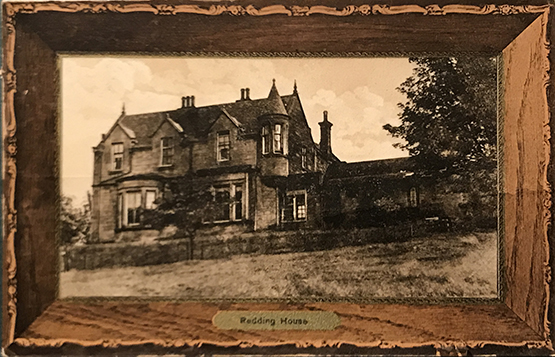
Redding House and Walled Gardens, built c.1862. was acquired in 1990 and extensively restored over a two-year period by its current owners. 1858?
Yes, it has a turret!
The extensive grounds have been informally laid out to create the optimum setting for the grand house. Yet, they offer several surprisingly intimate and relaxing spaces, such as the contemplative Cottage Garden. Tended lawns, wild grasses, and romantic flower-lined paths will lead you to a secluded, tranquil lily pond fed by a gentle stream – to the rear, a Pavilion overlooks the whole scene.
Ferns and raspberries transition into the surrounding Redding Wood. Here, on a woodland walk, you’ll find many mature deciduous specimens and come upon a magnificent Scots Pine-framed view across ancient Holly to the main house.

Redding Wood
The official website of the Central Scotland Green Network Trust, formerly known as the Central Scotland Countryside Trust, reminds us of a pretty remarkable partnership effort that resulted in the creation of the Central Scotland Forest.
In 1990, advocating for land designated for tree planting in the name of environmental preservation was a challenging endeavour. However, Central Scotland Forest’s commitment to the cause was unwavering. Our Creative Director, Don Jack, had already been deeply engaged with Central Scotland Forest during their brand development journey. He collaborated closely with CSFT to create Redding Wood at Redding House, a green space dedicated to restoring and protecting nature. This project enhances natural capital, regulates temperature, and improves air quality in an otherwise urban area.
Fast forward to today, their passion for environmental and conservation initiatives remains as strong as ever. Don Jack is a founding director of the Environmental Data companies: Bandanair UK and Bandanair US, as well as the Scottish heritage, bespoke tartan & luxury textile products company: Tartan Golf Bags.
Personal projects include being custodians of perhaps the most beautiful part of Loch Lomond & The Trossachs National Park, on the shores of Loch Ard, and the redevelopment of the former Drambuie corporate headquarters in Edinburgh’s York Place.
Touring Exhibition partnerships have proven invaluable in attracting and sustaining visitors to heritage landmarks. The company is delighted to support the Wizard of Oz archive at the Smithsonian’s National Museum of American History. It takes immense pride in the Scottish Museum of Movie Magic, boasting one of Europe’s most extensive archives of genuine movie-used costumes and props. With objects representing diverse academic, cultural, art and design disciplines, these spectacular collections highlight the central role that props and costumes play in cinema storytelling.
IDEAS is steadfast in its commitment to conservation and environmental stewardship. They offer consultancy services to various innovative environmental enterprises, ranging from notable scale-up Standard Gas to the conservation charity, the National Trust.
The IDEAS story is one of enduring dedication, transforming landscapes and preserving nature for generations. Redding Wood remains a cherished project.


Redding House and Walled Gardens history
Before Redding House and Walled Gardens.
In 1859 land was purchased by the Coalmasters James Russell Senior and James Rusell Junior and was part of the Landsand Estate of Westquarter in the parish of Polmont, sometime possessed by Ebenezer Erskine as part of the lands of Overton in the ownership of Thomas Fenton Livingstone.
Thomas Fenton Livingstone, Esquire, of Westquarter, was the only son of John Thomas Fenton, Esquire, and Selina, younger daughter of the late Sir John Edensor Heathcote, Knt., of Longston Hall, Staffordshire. He was born in 1829; succeeded his grand-uncle, Admiral Sir Thomas Livingstone, Bart., of that ilk, in 1853, when he took the additional name of Livingstone; and in 1855, married Christian Margaret, only daughter and heiress of William Waddell, Esquire, D.L., of Moffat House, Lanark. Mr. Livingstone has, with other surviving issue, John Nigel Edensor, born in 1859.
From The History of Stirlingshire.
Chapter XXVII – Titled and Untitled Aristocracy.


In 1848, the Stirlingshire Midland Railway cut through the Westquarter of the Redding estate on its path from Polmont Station to Grahamston Station. The heaviest part of the work consisted of a deep cutting through a hill composed principally of hard blue till. The hard-working team of labourers dug this out by hand and wheeled it to the north of Callendar Park, where it was used to form an embankment. Towards the north end of the cutting, almost immediately to the south of Westquarter House, they encountered bedrock. Upon examination, it was found to be high-quality blonde sandstone and used to build the bridges and station buildings on the line. The land purchase for the railway and the stone extraction contributed to the Westquarter estate coffers. *Stone from the quarry was subsequently used for house building.
falkirklocalhistory.club


1924- The Redding Pit Disaster- the surviving miners. These were the men who were trapped in the Mine for 10 days. While trapped, the five had nothing to eat, only brackish water to drink and no light for fear of firedamp. They spent some time sharing their experiences of the First World War. They were in good condition when rescued, and were sought after to speak at concerts held for the disaster relief fund. The men were: From left to right- John Miller, Andrew Thomson, Robert Ure, James Jack and John Donaldson.
On a hill beyond Redding is a stone that is called Wallace’s stone, marking out the spot from which Sir William Wallace, after his quarrel with Sir John Stuart, one of the Scottish chiefs, is said to have viewed the Battle of Falkirk, from which he had been compelled to retire, and to have witnessed the defeat of the Scottish army.
For Sale.
“Redding House, near Polmont, containing dining room, drawing room, parlour, library, four bedrooms, with two large dressing rooms; besides kitchen, butler’s pantry, scullery, bath-room, servants’ bedrooms, wash-house, & c., together with six acres and a half of ground. The house is in first-rate order, having been recently built by the proprietor for his own occupation, and is situated within a mile of Polmont Railway Station. For further particulars apply to John Smith and Wilson, writers, Falkirk.” [Falkirk Herald 7 April 1866].,
“Desirable residence for sale. For sale, privately, with immediate entry, that desirable property, near Polmont Station, known as Redding House, containing 3 public and 5 bedrooms (2 with dressing-rooms), bathroom, kitchen etc, etc,: also land adjoining House extending to about 12 acres, and small cottages thereon, yielding rental of £37. [Falkirk Herald 19 Oct 1901],
“That eligible residence known as Redding House, with garden, ornamental grounds and land. The House, which is a substantial modern building, contains 3 public rooms, 5 bedrooms (2 with dressing-rooms), bathroom, kitchen 2 servants’ rooms, etc, etc and cold water. The land extends to about 12 acres, and along with several small houses thereon yields a rental of £37. [Falkirk Herald 18 Jan 1902]
Family memoirs

Floral Clock, Dollar Park. Dedicated to Provost William McCrae (Papa) Burgh of Falkirk 1968 -1971.
Provost William McCrae
William McCrae was born in Ballantrae, Ayrshire, in 1905 and was raised by relatives in various parts of Scotland. His mother emigrated to Canada in 1913, to Dauphin, Manitoba and married her cousin, whose first wife had died fairly young, leaving him with two young boys. The family had been original Manitoba Pioneers, having bought a plot of land from the Canadian Government for $10 and built a log cabin on the prairie. Later, they built a larger, better house in Dauphin.
He grew up, mostly in Ayrshire, worked on P&O Ocean Liners and later married Mary, raising a family in Falkirk: Margaret, Nan and Billy.
He was deeply involved in trade union work (the Railways) and local government, having been a Town and County Councillor and latterly Provost of Falkirk.
Below: awarding the Freedom of the Burgh to The Argyll and Sutherland Highlanders, 1972.
Johnston Press


Painted for the Lady Provost Mary (Nana) MacRae (when I was aged Eleven), Eilean Donan Castle is recognised as one of the most iconic images of Scotland. Situated on an island at the point where three great sea lochs meet, and surrounded by some majestic scenery, it is little wonder that the castle is now one of the most visited and important attractions in the Scottish Highlands.
There are four generations of the MacRae family, past, present, and future, who are still the Constables of Eilean Donan Castle today.
Kirsteen Grant
Glasgow Islay Gaelic Choir

Rachel Buchanan MBE
Aunt Rachel was awarded an MBE in 1986 for her work with ENABLE Scotland.
An appreciation of Rachel Buchanan was written by Norman Dunning, chief executive of ENABLE Scotland, and Professor Andrew Jahoda, a member of ENABLE Scotland. It reads:
A nurse, a mother, a campaigner for people with learning disabilities; she injected passion and compassion into everything she did, and her enthusiasm rubbed off on everyone she met.
Born in Cardross in 1915, to Donald and Margaret McInness, and educated at Cardross Primary and Hermitage School, Rachel went on to travel the world — and to change it.
She was persuasive, yet understated. As a campaigner, she was not afraid to challenge the status quo, but neither did she make enemies. She succeeded by gaining allies and making figures of authority feel good that they were doing the right thing.
She was awarded the MBE in 1986 for her work with ENABLE Scotland, but true to form, she insisted the honour should be for everyone involved at her local branch in Helensburgh, not for her as an individual.
Rachel, who was born on September 20 1915, began her nursing career in the 1930s with fever training at Belvedere Hospital, before general training at the Western Infirmary and midwifery in Perth.
She joined the Queen Alexandria Nursing Service in 1944, and after serving in India, she was one of the first nurses to enter a Japanese prisoner of war camp in Singapore.
She was one of the few witnesses to the surrender of Japanese war Generals to Lord Mountbatten.
In her time in Singapore, she must have seen terrible things, but she rarely spoke of it, except to say that she went to a lot of dances and chased doctors.
In 1950, Rachel was married to optician William Buchanan. They went on to have four children: Mairi, Douglas, Donny and Robert.
It was the birth of Donny, who has learning disabilities, in 1956 that had perhaps the most profound effect.
Rachel, Donny and William joined the Dumbarton branch of the Scottish Society for the Mentally Handicapped, which later became ENABLE Scotland.
They soon realised more had to be done locally and became founding members of the Helensburgh branch.
Rachel’s contribution to ENABLE Scotland and to people with learning disabilities across Scotland was legendary.
She was a true pioneer who, despite her responsibilities for her family and, especially, for Donny, went out of her way to support others in similar circumstances.
It was Rachel’s ability to enthuse others that really made a difference. She was involved in a range of groundbreaking projects, from the Stewart Home — the first respite home for children and adults with learning disabilities in Scotland — to daytime provision for children with significant needs, shared holidays, and community housing.
She remained open to new ideas throughout her life and was not in awe of anyone.
While her contribution to the wider community was extraordinary, Rachel’s whole being and sense of purpose were forged in the solidity of strong family attachments and loyalties, to which she became central.
Her professional skills were put to use caring for Donny, as well as nursing her father and, eventually, her husband.
To the end, Rachel retained her sense of humour and her concern for others. In the note she left for her funeral arrangements, she wrote a simple message: “Smile, and the world smiles with you.”
